SRN-901: A Longevity Drug Candidate Shows Promise for Extended Lifespan and Healthspan
Seragon Pharmaceuticals has published preclinical data on SRN-901, a novel longevity compound demonstrating significant lifespan and healthspan extension in animal models. The findings represent a step forward in pharmacological interventions targeting fundamental aging pathways, with implications for how wearable users might contextualize aging biomarkers.
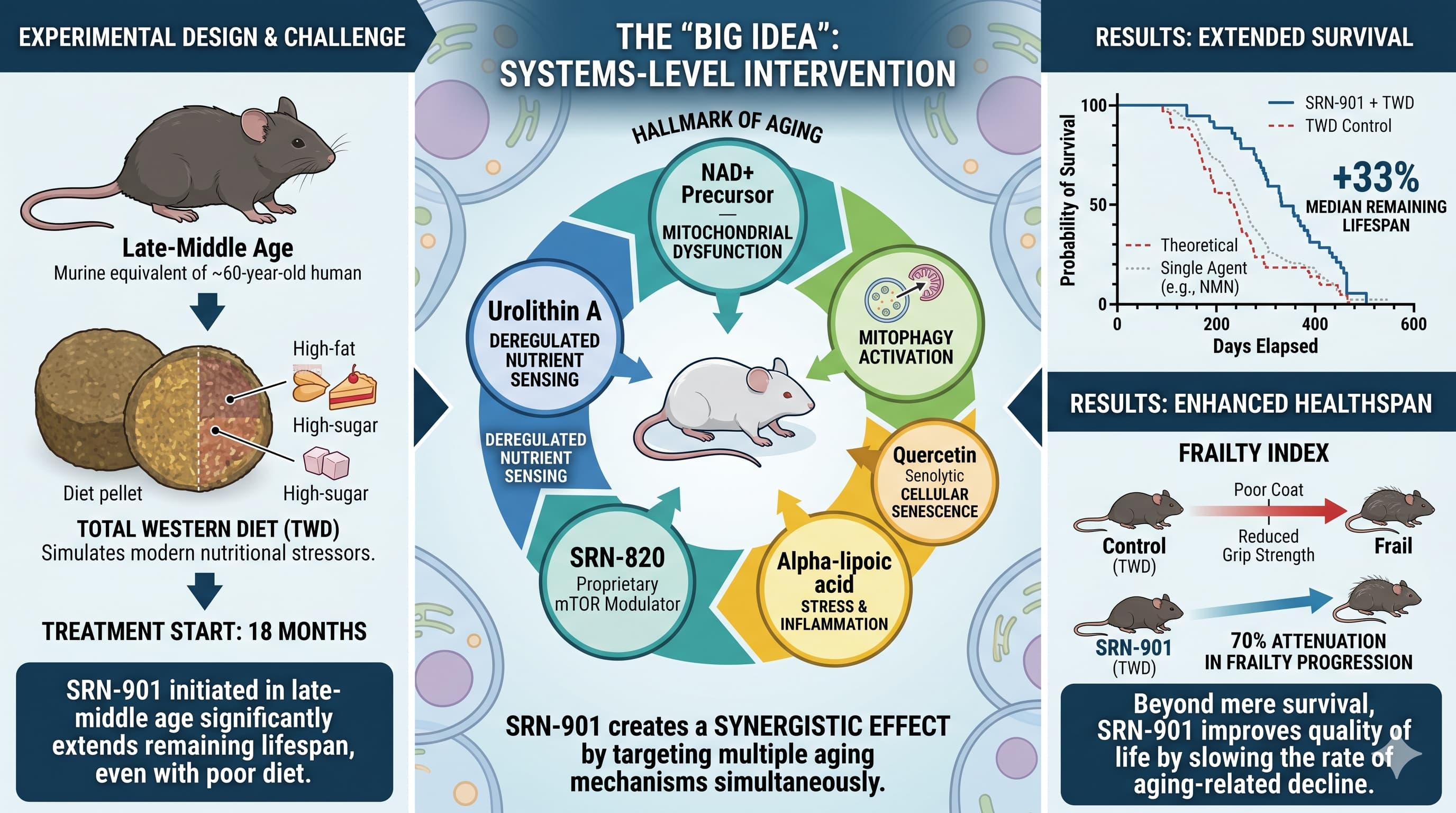
The pursuit of therapeutics that slow aging and extend healthy lifespan has long occupied the margins of mainstream medicine. Recent publications from Seragon Pharmaceuticals bring renewed attention to this field, as the company releases data on SRN-901, a small-molecule compound designed to address cellular and molecular hallmarks of aging. Unlike symptomatic treatments that manage age-related diseases in isolation, SRN-901 targets upstream mechanisms believed to drive multiple age-related pathologies simultaneously. This approach—sometimes called "geroscience"—attempts to extend not just total lifespan, but healthspan: the period of life lived free from chronic disease and functional decline.
Seragon's published data demonstrates that SRN-901 produced measurable lifespan extension and improvements in age-related health markers in preclinical models. While specific efficacy data from the source remain limited in the public summary, the compound's mechanism reportedly engages pathways involved in cellular stress resistance, metabolic regulation, or senescent cell clearance—all areas of intense longevity research. The distinction between lifespan (total years lived) and healthspan (quality years lived) is critical here: a drug that simply extends years without preserving function offers limited value. Seragon's emphasis on both metrics suggests the compound may preserve physical and cognitive performance alongside chronological longevity gains.
For users of longevity-focused wearables and health-tracking applications, this development carries both scientific and practical significance. Wearable devices capture real-time biomarkers—heart rate variability, sleep architecture, activity patterns, resting metabolic rate, and inflammatory markers—that correlate with biological aging. If SRN-901 or similar compounds enter clinical trials in humans, these wearable metrics could become valuable endpoints for measuring drug efficacy outside formal laboratory settings. A medication that genuinely slows aging should produce detectable shifts in these biomarkers: improved HRV stability, more efficient sleep staging, reduced inflammatory signatures, or enhanced metabolic flexibility. Longitudinal wearable data might even enable early detection of responders versus non-responders in future trials.
The pathway from preclinical promise to clinical reality remains long and uncertain. SRN-901 must progress through IND-enabling studies, Phase 1 safety trials, and ultimately Phase 2/3 efficacy trials in human subjects before regulatory agencies would consider approval. Animal models often fail to translate to humans, and aging itself is a complex, multifactorial process influenced by genetics, environment, and behavior—variables difficult to control pharmaceutically. Additionally, regulatory agencies have historically been skeptical of "anti-aging" claims, preferring disease-specific endpoints (e.g., reduction in heart disease incidence) over broader claims about aging reversal or extension. The company's decision to publish preclinical data represents a commitment to scientific transparency, but published data are distinct from regulatory approval.
For wearable app users and longevity enthusiasts, Seragon's SRN-901 data underscores an evolving reality: pharmacological approaches to aging are moving from theoretical interest into experimental medicine. However, it remains crucial to distinguish between published preclinical findings and clinical utility. No longevity drug is currently approved by major regulatory agencies for the indication of "aging" itself. Current best practices for healthspan extension—consistent physical activity, sleep optimization, metabolic health, stress management, and social connection—remain evidence-based and immediately actionable. Wearables excel at measuring adherence to these foundational behaviors and detecting early warning signs of metabolic or cardiovascular decline. As pharmacological longevity interventions mature, wearable data may become increasingly valuable for personalizing treatment and monitoring outcomes, but behavioral and lifestyle foundations remain irreplaceable.
The broader implication of compounds like SRN-901 is philosophical as much as scientific: aging is increasingly viewed not as an inevitable decline but as a targetable biological process. This shift opens possibilities for precision longevity medicine, in which wearable biomarkers guide treatment selection, dose adjustment, and outcome assessment. Until such compounds are clinically available, wearable users can leverage their devices to track the modifiable risk factors and lifestyle behaviors that current evidence supports—and to establish baseline biological aging trajectories that may, in the future, help measure the impact of emerging longevity interventions.
Source: BioSpace